Humanity, Earth, and the Possibility of One Wider Spiritual Language
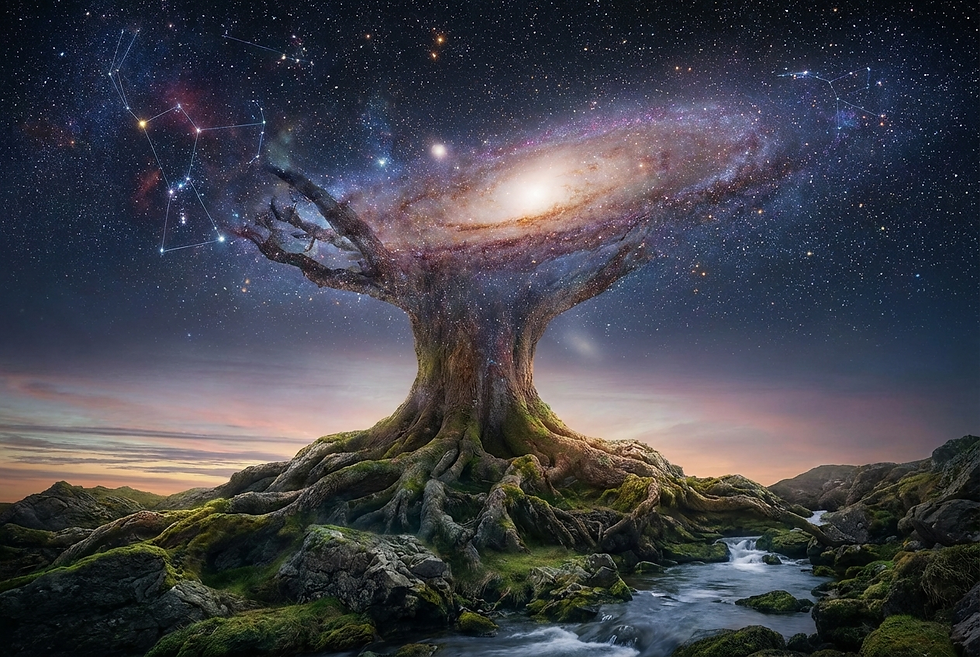
The Root of Belief
The more I study religion, ancient civilizations, spiritual systems, and the evolution of belief, the more I find myself returning to one simple thought: maybe humanity has always been trying to understand the same mystery, only through different environments, different eras, and different language.

When looking at what some call the evolutionary tree of religion, one of the first roots often shown is animism, the belief that nature itself carries spirit, life, presence, or consciousness.
Before organized religion, temples, and formal scripture, early humans often thought of the world as being alive. Rivers weren't just rivers, mountains weren't just rocks, and animals weren't just things that moved through the land. Everything seemed to have a purpose.
That says something deep about what makes us human. Before theology, maybe people first had relationships with the earth, the sky, storms, seasons, ancestors, death, and even survival. From there came shamanism, where certain individuals became interpreters of unseen realities, and then polytheism emerged as civilizations began giving names and identities to the forces they felt around them. Sun gods, river gods, fertility gods, gods of war, and gods of wisdom all reflected how people interpreted the conditions surrounding their lives. Desert cultures saw God differently than forest cultures, and agricultural civilizations interpreted divinity through harvest, drought, and seasonal cycles. Human belief has always been shaped by the world surrounding it.
Earth as Spiritual Foundation
This understanding is why I often say religion may be deeply tied to Gaia, to Earth itself. We are children of earth from birth to death. Our bodies are formed from the planet, our rhythms follow the sun, and our breathing depends on ancient ecosystems built long before us. Even our spiritual imagination is grounded in mountains, oceans, fire, storms, stars, and seasons. When I think about movies like Avatar, what interests me is not just fantasy but the idea of a society that fully understands how it fits into the world. It asks a question that people have always quietly struggled with: what does it really mean to be part of a living environment?
If Humanity Leaves Earth
Yet that thought leads me further. If humanity one day becomes space-based, what happens to that relationship? If humans live on Mars long enough, what would spirituality become there? Mars is dry, silent, cold, open, and desolate compared to Earth. Beauty there would likely be defined differently. Beauty would potentially become a rarity itself, like the sight of water, warmth, growing life, shared shelter, and breath itself.
Even love could assume a different form. Would love become less romantic and more survival-based, more rooted in empathy, trust, and emotional interdependence because every human presence would matter more in such a fragile environment?
If thought itself felt closer to reality, if inner consciousness seemed to manifest more intensely because of isolation, survival, and environment, then spiritual experience on Mars might become very different from anything Earth has produced. Prayer might even change. Religion on Earth has always reflected rivers, soil, weather, and cycles of life, but a Martian spirituality may reflect silence, distance, memory, and longing. Earth religions often speak of heaven above, but what happens when humanity lives between worlds? Would Mars create a faith centered on remembering Earth? Would Earth become sacred memory? Would the first trees grown on Mars become holy symbols? Would the first child born there see the stars differently than we do?
Consciousness Beyond Environment
If another civilization existed somewhere else entirely, shaped by different gravity, atmosphere, light, and time, then possibly what they call "spirit" would emerge through their own conditions too. That raises an even deeper question: is being human primarily about the environment, or is there something deeper that survives beyond the environment?
Anthropology suggests humanity spent vast stretches of existence simply surviving, evolving, adapting, and moving through what might almost be called an evolutionary slumber before fully symbolic consciousness bloomed. Then suddenly there was burial, ritual, myth, art, symbols, memory, and transcendence. Matter became aware enough to ask what it is.
Maybe every religion since then has simply been a language attempting to answer that same question. Different names, different systems, different rituals, yet all circling one mystery: what are we? Are we children of Earth, children of the sun, children of the cosmos, or consciousness itself learning to recognize its own reflection through life? Maybe all of them are true in part, and wherever human beings go, meaning follows.
Unity Without Destruction
What I find myself realizing more and more is that humanity may not ultimately come together through destruction, even though history often suggests that major crises can force temporary unity. To be clear, I would never desire anything remotely close to nuclear war, large-scale catastrophe, or any event rooted in devastation simply to produce cooperation. That is not my view, nor is it something I believe humanity should ever require in order to find common ground.
For a long time, however, I understood why some people hold the belief that a major shared threat could awaken humanity to how deeply connected we truly are. Whether imagined as an internal danger, such as nuclear escalation, or an external unknown beyond Earth, the idea has often been that something larger than our divisions might force people to see one another differently. I can admit that I once understood a small part of that reasoning, but not because I thought destruction was the answer. History shows that people often realize how much they depend on each other when they are in danger.
The more I think about it now, the more I realize that kind of unity would still come through fear, and fear has never truly sustained human transformation. Fear may produce reactions, but it rarely builds lasting understanding. It does not fully align with how I now see our potential.
What seems far more meaningful is the idea that cooperation itself remains the true foundation, not only for life on Earth but also for anything humanity hopes to become beyond Earth. Even space travel, which many imagine as a technological achievement, would ultimately depend on trust, shared purpose, and collective responsibility. If people are ever going to become something better, it will probably be because we chose to work together instead of being forced to do so by a crisis.
One Wider Spiritual Language
Maybe for the first time in human history, one group of humans could not easily tell another group of humans what their emotional, neurological, or spiritual experience should mean, because the environment itself would be changing consciousness. A person on Earth could describe faith through rain, oceans, forests, seasons, and atmosphere, while a person on another world may describe faith through silence, red horizons, enclosed life, artificial air, distance from oceans never touched, and stars seen through another lens. The human experience would still be human, yet undeniably different.
That creates a profound question: how does one human fully interpret another human experience when both are shaped by entirely different worlds? Maybe that becomes the beginning of a wider spiritual language. Not a single religion replaces all others; instead, a broader human understanding recognizes that consciousness itself is being shaped in new environments.
Earth has always written much of our spiritual vocabulary. Mountains became sacred, water became cleansing, fire became transformation, and the sky became transcendence. But once humanity lives beyond Earth, new symbols will emerge, new metaphors, new questions, and new forms of wonder. Maybe for the first time humanity will not simply ask what we believe but how the environment itself participates in belief.
At that point, the deeper truth may become unavoidable: humanity is one species, yet consciousness is always responding to where life is lived. Maybe that is how humanity slowly moves toward one wider spiritual language, not by erasing difference, but by finally understanding that difference itself may reveal something sacred.